Updated October 2026
I am currently a Marie Skłodowska-Curie Postdoctoral Fellow at Center for Star and Planet Formation (StarPlan) in University of Copenhagen, working with Prof. Anders Johansen.
I got my PhD degree in astrophysics in 2021, at Kavli Institute for Astronomy & Astrophysics, Peking University (with Prof. Greg Herczeg and Prof. Xuening Bai),
and worked as a postdoc researcher from 2021-2024 in CRAL, ENS de Lyon (with Prof. Guillaume Laibe).
I am particularly interested in studying protoplanetary disks surrounding young stars,
which are believed to be the birthplaces of planets. My research interest focuses on studying dust dynamics
and planet formation processes in protoplanetary disks using MHD simulations,
as well as investigating physical processes involved in disk formation and evolution, including protostellar collapse
and disk winds.
Our simulations show that convection can rapidly remove sublimated volatiles from protoplanetary envelopes, supporting distinct hybrid formation pathways for Earth and Mars, with pebble accretion dominating Earth's growth and planetesimal accretion dominating Mars's.
Full study:
Wang, Johansen, Xu et al. (2026) · Nature Astronomy
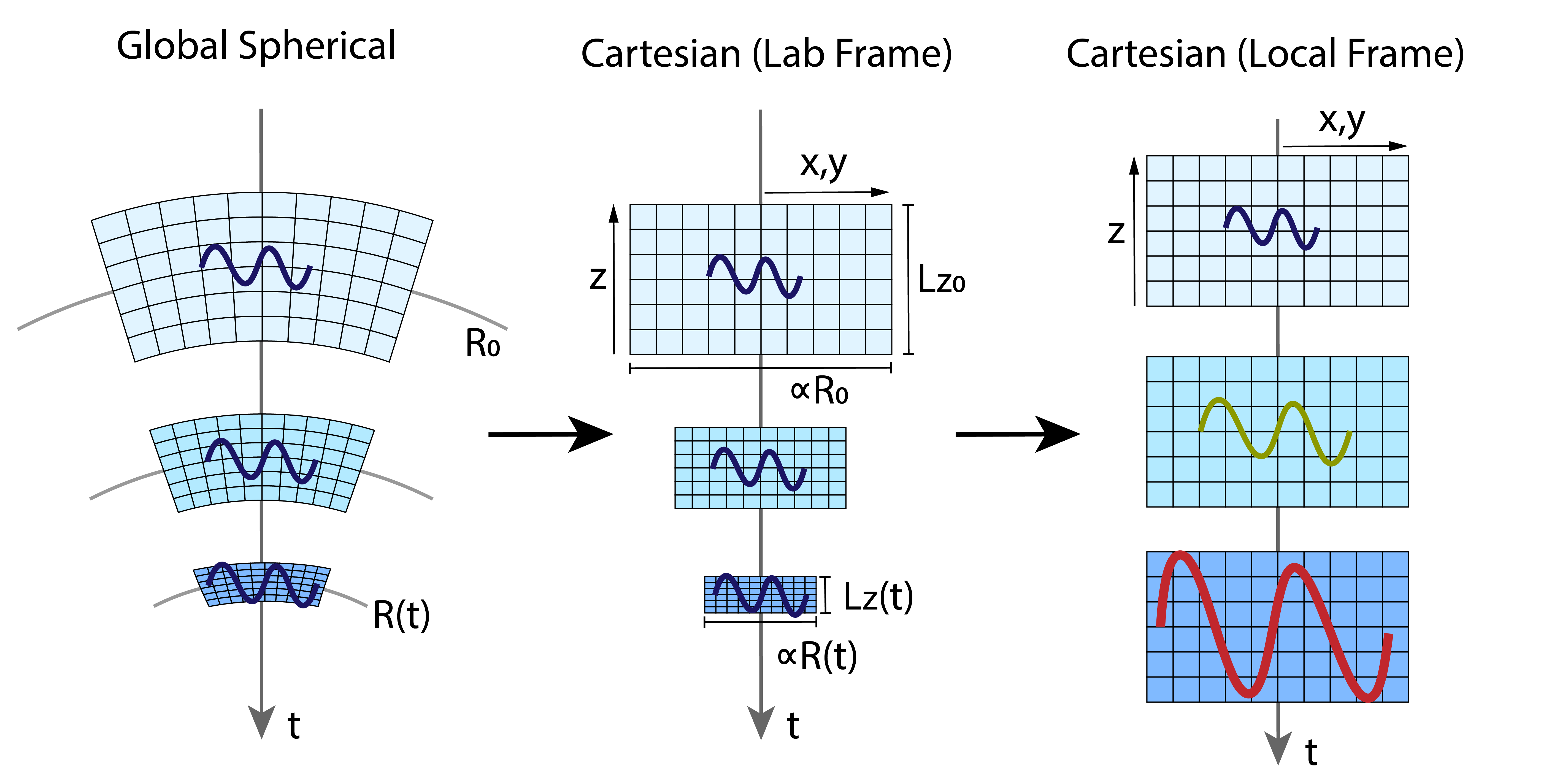
We implement a local model for a spherical collapsing or expanding gas cloud in the ATHENA++ magnetohydrodynamic code, providing a powerful framework for studying local physics and hydrodynamic instabilities during protostellar collapse.
In turbulent disks, dust feedback to the gas promotes dust trapping in gas pressure bumps and makes the dust rings narrower. Evidence of dust clumping is also seen at a near-solar global solid abundance.

Under realistic level of MRI turbulence, dust particles tend to settle to a thiner layer at the midplane and clump when the back-reaction from dust to gas is considered.

We analyze FUV absorption lines in HST surveys of 40 disk-hosting young stars, and detected wind absorption in most of them. Our wind models show that magnetized wind is needed to explain the absorption line profiles.
Planetary core formation by accreting pebble-sized dust particles remains efficient even under unrealistically strong MRI turbulence.


